The Legend of the Dragon Gate: A Folktale Your Students Actually Need

At some point in your life, you've wanted to become a better version of yourself.
Maybe it was a fitness goal you kept pushing back. A skill you wanted to build. A version of your career that felt just out of reach. And maybe you started. And it was hard. And then something unexpected happened, something that had nothing to do with your effort or your preparation, and it got harder. And you had to decide whether to keep going anyway.
That's what this story is about. Except the main character is a fish. And if he makes it, he becomes a dragon.
The Legend of the Dragon Gate is an ancient Chinese folktale, and it's one of the most theme-rich, discussion-ready, symbolism-packed stories I've ever brought into a classroom. I want to tell you about it, and about what I added to it, because I think it deserves a place in your teaching rotation.
I'd Actually Heard This Story Before
The first time I encountered the Dragon Gate legend, I was young, and it stuck with me mostly because of that transformation. A carp, an ordinary fish, swimming upstream against everything, until it reaches the Dragon Gate and becomes something extraordinary. A dragon.
The second time I encountered it was in a student textbook. I turned the page, started reading, and had one of those delayed reactions. Wait. I know this story.
And then the nerd in me kicked in.
Because if you know anything about Pokemon, you know Magikarp. Weak, flopping around, one of the most limited creatures in the game. Its move set is almost nonexistent. And yet, if you commit to it and grind all the way to level twenty, it evolves into Gyarados, a massive, powerful, genuinely fearsome force. The parallels are not subtle. And the moment I made that connection, I knew this story was tapping into something universal. If it inspired that, it runs deep.
Why This Story and Not Another One
Your students already know Little Red Riding Hood. They know Jack and the Beanstalk, the Three Little Pigs, Aesop's fables. There's value in those, absolutely. But they're familiar. Well-worn. And familiarity is the enemy of engagement.
A story about a carp battling its way to a dragon gate? That's something different. That's the kind of premise that gets a student to actually lean in before you've said a word about theme or symbolism.
But beyond the engagement factor, there's something else happening when you bring folktales from other cultures into your classroom. Most of your students won't have heard this one. That unfamiliarity is an asset. You're not just teaching ELA skills, you're quietly expanding their world. The philosophies baked into stories from Asia feel different from the ones baked into Western fairy tales. The attitudes toward perseverance, toward community, toward what it means to keep going when things are hard, these shift depending on where a story comes from. And students absorb that without even realizing it.
I Didn't Just Retell It. I Amplified It.
When I decided to build a resource around this story, I knew I didn't want to just regurgitate what already existed. So I asked myself: how do I make this richer? How do I make it more honest?
The original legend is about perseverance and determination. What it was missing, in my opinion, was the full picture of what perseverance actually looks like in the real world. So I added three layers that I think every student, and honestly every adult, will recognize.
The haters. When you commit to something hard, whether it's a fitness journey, an academic goal, or a small business you're trying to build, there will be people who try to pull you off your path. Not always intentionally. But they're there. The ones telling you that you're trying too hard, that you should come out instead of studying, that you're embarrassing yourself by even trying. I put those characters into the story. Because they exist.
The people who fall away. You won't finish hard journeys with the same people you started them with. Some will commit alongside you and quietly disappear when it gets difficult. Learning to keep going after that, without bitterness, without losing momentum, is its own kind of skill. That's in the story too.
The curveballs. This one is maybe the most important addition. In my retelling, the carp is making progress, actually climbing, actually gaining ground, and then it starts to rain. No reason. No warning. It just gets harder. And then the gods, watching the struggle, decide to make it harder still. And then, right near the finish line, monkeys start throwing rocks.
That last one sounds almost funny when you say it out loud. But it isn't, because every person reading this knows that feeling. You're almost there. You can see the end. And something completely outside your control gets in the way. What do you do?
The story's answer is the same every time: you wait, you recover, and you keep going. Days pass. Then weeks. Then months. Then years. That repetition is intentional. Because sometimes the only way through is time. It's a marathon, not a sprint, and the carp learns that the hard way.
Younger students might not catch every layer. But older students will. And that's where the real discussion starts.
What This Story Does in a Classroom
When I started building the materials for this unit, I kept surprising myself. Every activity led to another angle, another discussion question, another writing prompt. This story is a short read, but it is an endless well.
Theme and symbolism are the natural entry points. The carp, the waterfall, the Dragon Gate itself, all of it is layered with meaning students can dig into. For developing writers, this story is a strong candidate for analytical essay writing. The symbolism is accessible enough to find but rich enough to actually say something about.
Discussion goes deep fast. Questions like "Why doesn't the carp give up?" and "What would you do if you were almost at the finish line and something knocked you back?" connect directly to students' real lives. That connection isn't a stretch. It's the whole point.
And the SEL component here is genuinely underrated. Students have to put themselves in that carp's position. Feel the weight of the journey, the setbacks that aren't fair, the people who disappear, the rain that comes out of nowhere. That kind of empathy-building is what social-emotional learning is supposed to look like in practice.
One thing I've noticed across a lot of the classrooms I've worked in is that students don't always have a lot of gumption. The culture right now leans toward modification and accommodation, and that has its place. But sometimes kids need a story that just says: it's okay to push through. It's okay for things to be hard and unfair and slow. That's not a reason to stop. That's how you become a dragon.

Teacher Tip: Use the Pokemon Angle
If you're anticipating buy-in to be a challenge, or you just want a bridge from something familiar to something new, bring up Magikarp.
Magikarp is one of the weakest Pokemon in the game. Its move set is almost nonexistent. It barely does anything.
But if you keep it in your party and grind all the way to level twenty, it evolves into Gyarados, a dragon-type powerhouse that looks incredible and hits hard. The transformation is dramatic. The payoff is real. But you have to put in the work first, even when it feels pointless.
That's the Dragon Gate legend. A creature that starts with almost nothing, that looks unimpressive and limited, that has to push through a journey most others abandon, and comes out the other side as something extraordinary.
Spend two minutes on this before you introduce the story. You'll have the room.
This Story Is Bigger Than the Page
Here's something worth knowing: the Dragon Gate legend didn't stay on the page. It traveled.

In Japan, families fly carp-shaped streamers called koinobori during Children's Day, a tradition directly inspired by the Chinese legend of the carp leaping over the Dragon Gate. The streamers are flown as a wish for children's healthy growth and bright futures, carrying the story's core message of perseverance into a living cultural celebration.
Across China, the legend has been woven into festivals and community gatherings, with dragon dances and ritual celebrations that honor its themes of transformation and hard-won success.
This isn't a story someone invented to fill a textbook. It's a story that shaped how entire cultures think about effort, growth, and what it means to keep going. That changes how you read it. And it gives your students something to connect to that's much larger than a single classroom lesson.
The YouTube Video and Audiobook
I wanted this story to reach every student, not just the ones who can access it independently at grade level. So I created a free YouTube read-aloud and an audiobook version.
Pull up the video, press play, and the whole class is in it together. Pause for vocabulary. Pause for discussion. Let students read along or just listen. The multimedia format makes this a genuine classroom tool, not just a reading passage.
Watch the read-aloud right here:
One Thing I Want You to Remember
The world is full of folktales we've never taught. Stories from cultures that carry their own philosophies, their own heroes, their own hard-earned wisdom about what it means to be human. We are a small portion of the world, and most of our classroom reading lists reflect that.
The Dragon Gate legend is one step toward changing that. And once you start looking, you'll find that well is very deep and very far from dry.
Ready to Bring This Into Your Classroom?
Start with the free YouTube read-aloud above. Let your students watch it. See what happens.
And if you want the full experience, including the complete retelling, reading comprehension passages on the story's real cultural footprint across Asia, discussion questions, essay prompts, and more, the complete Reading and Writing Mini-Unit is available now at Learning Forge Academy on Teachers Pay Teachers.
You can find the resource below
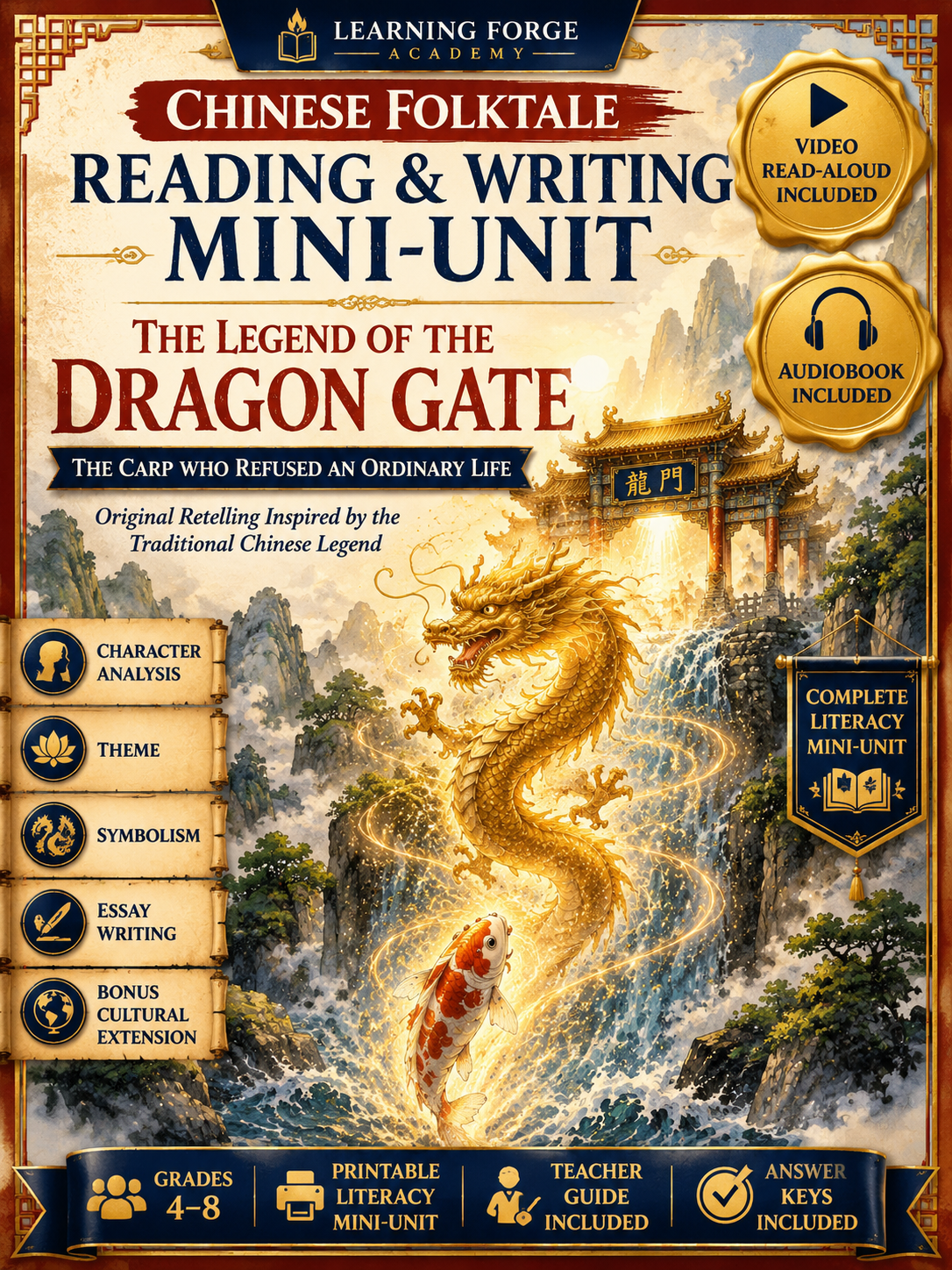
Your students are ready to become dragons. Give them the story that shows them how!
That's all from me on this one. If you have thoughts, questions, or you end up using this story with your students, let me know how it goes. You can comment below or find me through the contact page. I read everything.