Character Forge: How I Turned Student Obsessions Into a Character Analysis and Creation Project

Every creative writing unit I've ever taught hits the same wall.
It doesn't matter how well I've set it up or how much energy I've brought to the introduction. At some point, I ask students to create a character (a real one, with depth and motivation and a reason to exist) and I watch the room go quiet in a particular way. Not the quiet of deep thinking. The quiet of people staring at a blank page, waiting for something that isn't coming.
And then, predictably, someone raises their hand and says: "Can I just make myself the main character?"
Every time.
I used to push back on it. I'd say, "I want you to create someone new." And students would try. They'd write down a name, give the character a cool power, maybe a color palette they liked. And what I'd get back was a collection of traits that didn't connect to anything. A character who existed in name only.
Here's the thing though: I get it. Creating a rich, believable character from nothing is genuinely hard. It's hard for professional writers. It's hard for me. The blank page problem isn't a laziness problem. It's a reference problem. Students didn't know how to build something they'd never been shown how to study.
So I started thinking differently about the whole process. What if, instead of asking students to create a character out of nowhere, I asked them to reverse-engineer one they already loved?
That question became Character Forge.
The Idea Behind the Project
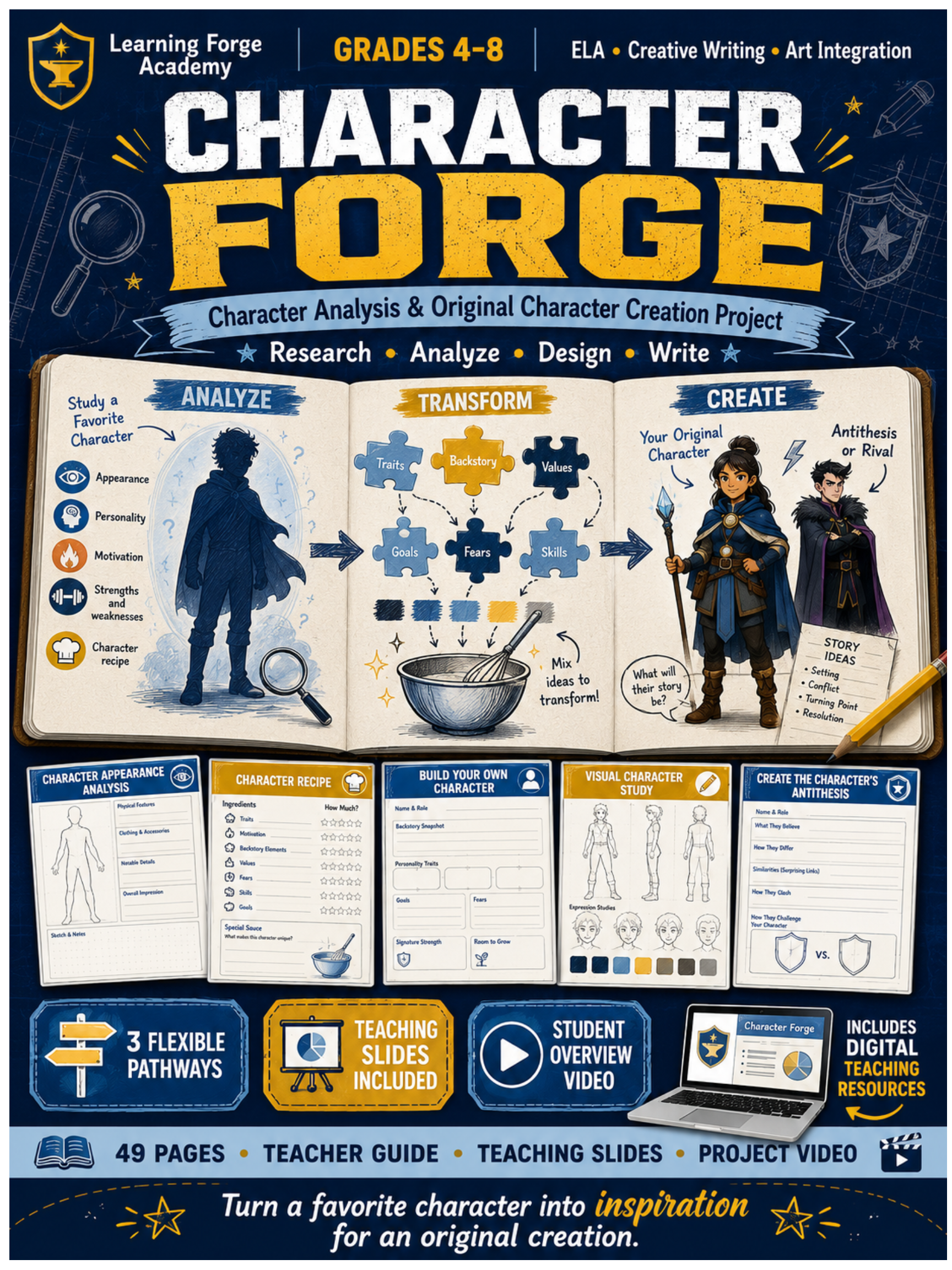
Character Forge is a fully modular character analysis and creation project for grades 4 through 8. Teachers choose the sections that fit their timeline, their students, and their goals. The full resource is 49 pages. A three-day version might use five. Everything in between is fair game.
The core experience looks like this: students choose a favorite character from any source: a book, a video game, a movie, an anime, a comic, a myth. They study that character deeply. They analyze appearance, personality, motivation, strengths, weaknesses, relationships, and backstory. They identify what archetype the character fits. They examine what design choices are intentional and what those choices communicate.
And then, using everything they've learned, they build their own original character from scratch.
The phrase I kept coming back to while building this project was study the recipe, not the result. It's the core idea. When a student looks at Naruto Uzumaki, it's easy to see the result: the orange jumpsuit, the whisker marks, the relentless energy. But the recipe is something different. The recipe is the orphan who craved belonging, the village that rejected him, the mentor who finally saw him, the goal that gave all that pain a direction. Understanding the recipe is what allows you to do something with it. Without that understanding, you're just copying the surface. With it, you can actually create.
The Full Arc of the Project
Here's what the complete Character Forge process looks like from start to finish.
Students choose a character they love from any source. They research that character, learn to evaluate their sources, and gather real information rather than surface impressions. They analyze the character from multiple angles: appearance, personality, motivation, strengths, weaknesses, relationships, backstory. They identify what archetype the character fits and examine whether their appearance communicates who they are.
Then they build the recipe. They take all of that analysis and distill it into a character ingredient list.
Then they create. Using inspiration from their chosen character (not copying it), they build an original character with their own recipe, their own biography, their own visual identity. Front view, side view, back view, expression studies, color palette, signature item.
Then they write. Origin story. Character biography. Narrative scenes. A crossover story where their original character meets the established character they studied. And if they're ready for more, they reverse the recipe and build the antithesis.
The full version of this project runs two to four weeks. A shorter version can be completed in three to six days and ends at character analysis. Everything in between is modular. Teachers choose the sections that serve their students and their timeline. No two classrooms have to run it the same way.
Why Student Interest Is the Strategy, Not Just the Hook
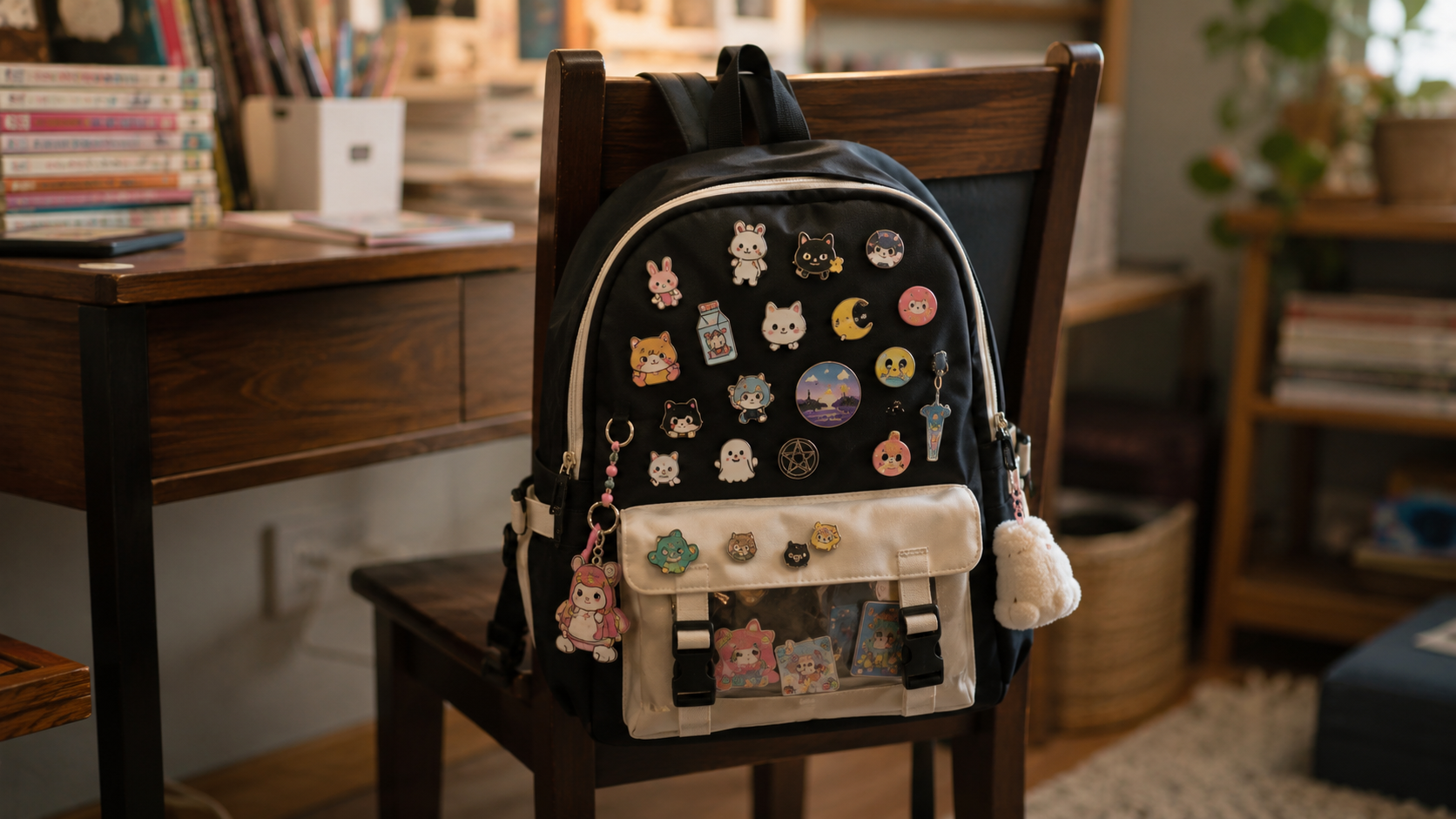
I want to be direct about something: letting students choose their own character isn't just a motivational trick. It's a pedagogical decision with real consequences.
Think about why students love the characters they love. Nobody forced a kid to put Sonic on their backpack. Nobody assigned them Goku or Naruto or Bluey or whatever character they've been obsessing over for the last two years. They chose those characters. And because they chose them, they have an emotional investment that no assigned text can manufacture.
When I asked students to analyze Jonas from The Giver, I got some great thinking from some students. But I also got a lot of kids who were working through the motions because they didn't particularly care about Jonas. The analytical muscle was the same. The fuel wasn't.
When students are analyzing a character they picked, something different happens. They already know things. They have opinions. They want to defend their character. They notice details they've never articulated before. The thinking starts warmer and goes deeper, because there's something at stake.
The challenge, as any teacher knows, is managing a room full of thirty different characters from thirty different universes. That's a real logistical tension. But I'd argue it's worth navigating, because the alternative of assigning everyone the same character solves the management problem while creating a bigger one: asking students to analyze something they feel nothing about.
What "Analysis" Actually Means
Here's a distinction that matters: describing a character and analyzing one are not the same thing.
Describing Mario looks like this: he has a red hat, a mustache, and blue overalls.
Analyzing Mario looks like this: why does he have an M on his hat? Where did those overalls come from? Why does he keep going back into dangerous places for someone he barely knows? What does that say about who he is?
Analysis is the why behind the what. It's asking questions at the surface and then following them down. A student who can describe a character has observed something. A student who can analyze one has started to understand how characters are constructed. That's a completely different skill, and a far more transferable one.
The worksheet structure in Character Forge reflects this. Students don't just list traits. They explain what those traits mean, where they come from, and how they connect to each other. Appearance connects to backstory. Motivation connects to weakness. Goals create conflict. Every piece is supposed to talk to the other pieces, because that's how real characters work.
The Recipe Metaphor (And Why It Stuck)
I didn't arrive at the "Character Recipe" concept through careful planning. It came to me because it's accurate.
Characters are made of ingredients. A recognizable appearance. A personality with texture. A goal that means something. A fear that creates stakes. A backstory that explains why they are the way they are. A symbol or signature item that communicates identity at a glance. Change the proportions of any ingredient and you get a different character. Change enough of them and you get someone entirely new.
The recipe metaphor also solves a problem I used to have when teaching creative writing: students would create characters by accident. They'd assign traits randomly, without thinking about whether they connected. A character who was shy, but also the most popular person in school. Incredibly strong, but with no reason to use that strength. Afraid of water, but no explanation of why.
When you think in terms of recipes, those gaps become obvious. A recipe with missing steps doesn't work. A character without connected ingredients doesn't feel real. The metaphor gives students a concrete framework for something that used to feel abstract.

Sugar, Spice & Everything Nice - Powerpuff Girls Gif
And honestly, this idea isn't new. Think about the Powerpuff Girls. Sugar, spice, and everything nice, plus one accidental Chemical X. That's a character recipe. The creators of that show understood something we want students to understand too: the ingredients matter, and so does what happens when you combine them.
In the resource itself, students fill out an ingredient list for their chosen character: species, color, power, goal, personality, weakness, symbol, special item. Then they use that list as the blueprint for their own creation. The teaching slides have an example character built out for reference: a blue electric capybara with super speed, a goal of protecting others, and a weakness of being impulsive. Every choice is intentional. Every ingredient connects. That specificity is the point.
Inspiration vs. Copying (A Conversation Worth Having)
This is the part of the project that surprised me, in terms of how important it turned out to be.
When I first started building Character Forge, I figured the creativity section would be straightforward. Use your chosen character as inspiration, make something new. Simple enough. But when I actually watched students do this work, I realized the line between inspiration and copying is genuinely hard to see when you're standing right next to it.
Students would take Sonic and turn him a different color. Done, original character.
That's not how it works. And it's not just about copyright (and copyright is real, worth understanding). It's about what originality actually means. A new color on an existing character isn't a new character. It's a paint job.
What I tell students, and what the resource reinforces, is this: take the ingredients, not the result. If you love Sonic, what specifically do you love? The speed? The attitude? The underdog energy? Great. Now ask yourself: what animal would carry those same qualities in a completely different way? What would their origin look like? What would give them their abilities, and what would that origin cost them?
That's how you get from Sonic the Hedgehog to a wind-blessed capybara who can run like a storm but loses his powers on a still, windless day. Same DNA, completely different character. That's transformation. That's what this project is trying to teach.
What Happens When You Reverse the Recipe
One of my favorite sections in the resource, and the one that started as an extension activity before I realized it was too good to be optional, is the antithesis.
After students have built their original character, I ask them to reverse the recipe.
Take your character's core values and flip them. Take their greatest strength and create a character whose entire existence is designed to counter it. Take their beliefs and hand those same beliefs to someone who sees the world in the exact opposite way, for reasons that make just as much sense.
That last part is important. The antithesis isn't just an evil version of the protagonist. Evil for its own sake is lazy writing. A meaningful antagonist has a worldview. They have reasons. They might even be right about some things. The conflict between a character and their antithesis isn't good versus evil. It's two different philosophies colliding, and neither one gets to be entirely wrong.
I had a student once who created a character who loved basketball, specifically because it was a team sport. His character believed you couldn't do anything meaningful alone. So I asked him: what's the opposite of that belief?
He thought about it and said: "Someone who thinks depending on people makes you weak."
And then he realized that character would probably be completely alone. Isolated. Not necessarily cruel, just convinced, maybe because of something that happened to them, that relying on others only leads to getting hurt.
That's a meaningful antagonist. That's a story worth writing. And it came from a fifth grader thinking carefully about what his main character actually believed.
Research Belongs Here

Here's something I've noticed consistently: students will tell you they know their favorite character inside and out. And in a sense, they do. They know how the character makes them feel. They know the patterns: what sets them off, what drives them, who they care about. They've absorbed the emotional truth of that character through hundreds of hours of watching, playing, and reading.
What they often don't know is the actual information.
Kids don't watch TV the way adults do. They catch episodes when they're on, half-tune-in during the slow parts, skip around on a tablet. Even a student who has seen most of a show has probably missed chunks of it. So when you ask them to research their character and fill in the factual gaps (where were they born, what's the name of the world they live in, do they have siblings, what's their official backstory), something interesting happens.
They start discovering things they didn't know they didn't know.
Sometimes it's small. A detail about a character's hometown, an official name for a power they'd been describing in their own words for years. Sometimes it's bigger. I've had students realize mid-research that two characters they'd always assumed were just close friends were actually related. And I've watched a student go very quiet at their desk and look up at me with wide eyes because they had just accidentally spoiled themselves on a plot point that hadn't happened in the episodes they'd seen yet.
That moment, equal parts hilarious and genuinely educational, is proof of something important. If you can spoil yourself doing research on a character you love, you didn't know that character as well as you thought. And that realization is exactly where the learning starts.
Character Forge includes a research section that walks students through the difference between primary and secondary sources, between official information and fan-created content, between observation and inference and opinion. Those aren't abstract concepts in this context. They're immediately practical. A student who finds conflicting information about Naruto's birthday on two different fan wikis has just experienced firsthand why you cross-reference your sources and start with primary material whenever possible.
That skill transfers everywhere. It's one of those moments in teaching where the "real" lesson and the "academic" lesson are the same lesson.
Who This Is For
Grades 4 through 8, but the honest answer is: any student who has ever loved a character.
That's most of them.
The project works for ELA classes, creative writing classes, art classes, gifted and enrichment programs, and homeschool families. The teaching slides support whole-class instruction. The student overview video lets students orient themselves to the project independently. It works for in-class introductions and for families working through it at home.
The three pathways (Character Explorer, Character Designer, and Character Architect) are not tiers of difficulty. They're tiers of depth and abstraction. The shortest pathway focuses on concrete elements: appearance and motivation, basic research, and a simple original character. The middle pathway goes into symbolism, origin stories, and visual studies. The longest pathway builds toward a full portfolio including the antithesis, crossover narratives, and philosophical analysis of what a character actually believes. Teachers can assign specific pathways for differentiation, or use the flexibility to meet students where they are.
For reluctant writers, the crossover writing component deserves a special mention. The idea came from real frustration in my classroom. I had students who could build a character, but the moment I asked them to write about that character in an original world, they shut down. So I tried something different: I told them to take their character and put them in a world they already knew. Put your capybara into the world of Sonic. Have him meet Tails. Now write about what happens.
The kid who had nothing to say five minutes ago suddenly had everything to say. Because he knew that world. He'd been living in it for years.
That's not a trick. That's meeting students where they are and using that ground as a launching pad.
Why I Built This
Character Forge took a long time to make. I'm not going to pretend otherwise.
But every hour of it made sense to me because of one thing I've come to believe pretty firmly as a teacher: students are capable of far more sophisticated thinking than we give them credit for. The problem usually isn't that they can't think deeply. The problem is that we're asking them to think deeply about things they don't care about.
Give a student something they already love and ask them to understand it on a new level, to study the recipe instead of just enjoying the result, and you'll see thinking that surprises you. You'll see a fifth grader arrive at a nuanced, philosophically interesting antagonist because someone asked him the right question. You'll see a reluctant writer produce three pages of crossover fiction because the world was already in his head and he finally had permission to put it on paper.
That's what this project is built for.
Character Forge is on Teachers Pay Teachers now, through Learning Forge Academy. If you want to see how the project is structured before committing, the student overview video walks through the full framework and all the components. The link is below.
And if you've got a room full of students who can tell you everything about their favorite character but have never been asked to explain why: this is the project for them.
[Embed student overview video here]
Project Overview Video Here!
You Can Find The Resource Below
Observe. Analyze. Create.
That's the whole idea. Thanks for reading, and I genuinely hope this gives you something useful to bring back to your classroom.
If you'd like to support Learning Forge Academy, you can find Character Forge and all my other resources in my Teachers Pay Teachers store. And if you have questions, ideas, or just want to talk shop, I'd love to hear from you. Drop a comment below or reach out through the contact page. This whole thing works better as a conversation.
Until next time.